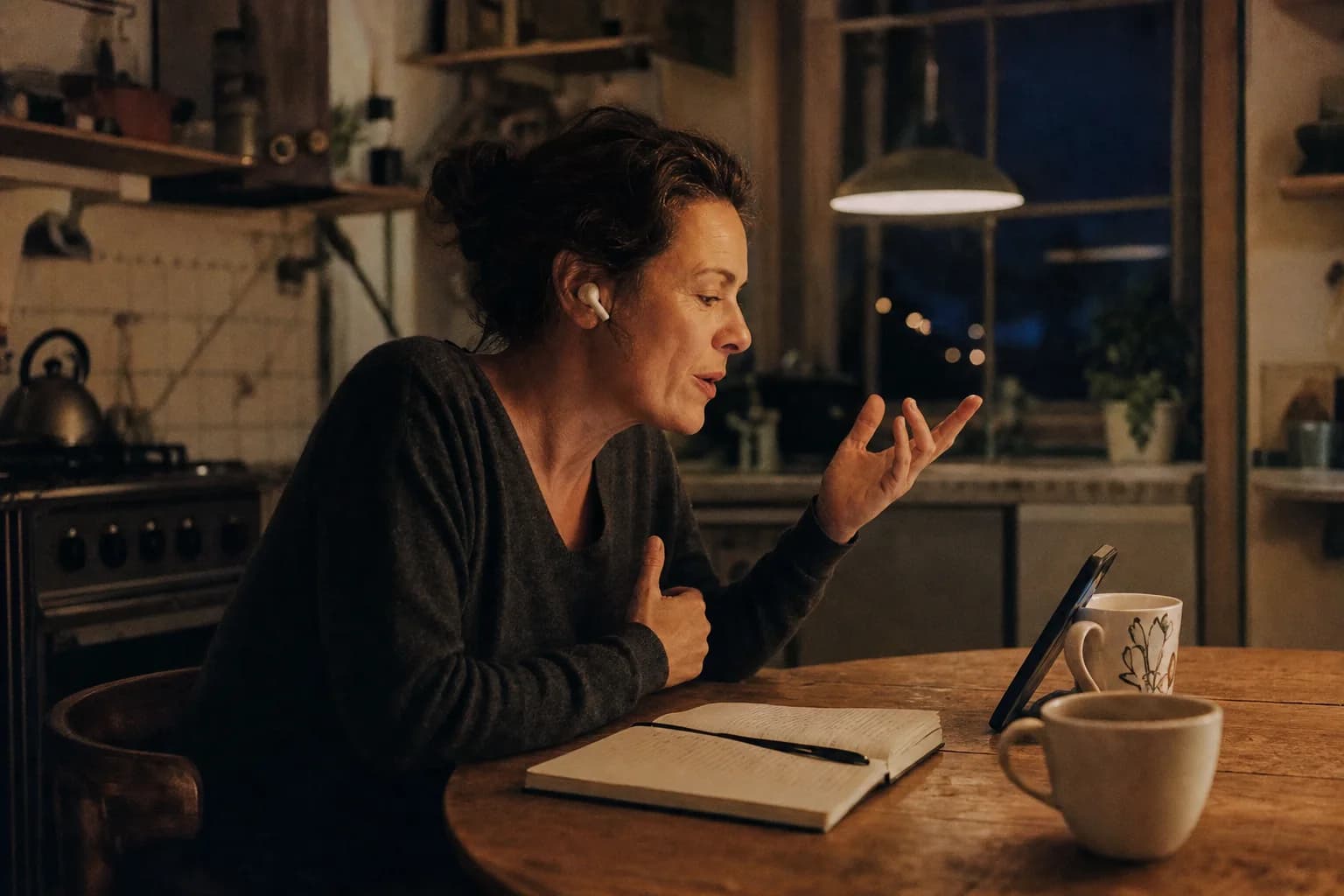
You can read French, and you can probably follow a podcast. But the moment you have to answer out loud, everything freezes: the words you know vanish, and you end up switching back to your own language. If that sounds familiar, don't worry - it may not be your vocabulary that's missing. To get better at speaking, you have to practice speaking, and for that you need someone to talk to, which many people simply don't have on hand.
That's where apps can help. Some let you talk to an AI, others connect you with a teacher or with real people. Here are the main options in 2026, what each does well, and where it falls short. At the end, you'll also find the phrases that save you when you freeze and a simple week to get started. This comparison is based on the information each publisher provides, and prices are the ones listed in October 2026.
The best apps for practicing spoken French in 2026 fall into three groups: conversations with an AI (Duolingo Max, Speak, Praktika, ChatGPT voice mode), one-on-one video lessons (italki, Preply), and exchanges with French speakers (Tandem, HelloTalk). 360 French Immersion is the only option in our selection that combines AI practice and real people: speaking out loud with Jean whenever you want, and video conversations with other students every week, in the same subscription.
Overview
- 360 French Immersion - practice alone with Jean and in groups at the conversation tables. €15.75/month (€189/year, billed once), 7 days free on the annual plan.
- Duolingo Max - video calls and role-plays with a character. Pricing depends on your country and is shown in the app.
- Speak - phrases to learn, then use with an AI tutor. Pricing depends on your region and is shown in the app.
- Praktika - AI avatars to talk to. About $8 a month according to the official site.
- Online private lessons (italki, Preply) - a real teacher on video. On italki, $4 to $60 an hour; on Preply, from $3, with an average of $21 per lesson.
- Language exchange (Tandem, HelloTalk) - free, with French speakers learning your language.
- ChatGPT voice mode - open-ended conversation, if you know how to give it instructions.
1. 360 French Immersion - speak alone with Jean and with real people
Full disclosure: 360 French Immersion is our own course, created by Elisabeth, a French teacher, and Mathieu. We put it first because we built it to solve exactly this problem, but you'll find its limits below, just like for the others.
The idea is simple: you turn on your microphone and talk out loud with Jean, who answers you by voice, in real time. Jean is a conversational AI. He puts you in everyday situations: at the bakery, at the doctor's, in a job interview or looking for an apartment, and adapts his vocabulary and pace to your level. You choose how he corrects you: either as you go, when he stops on a real mistake, gives you the right form and has you say it again, or only at the end, so you can speak without interruption. Either way, you get a report with your corrections after each conversation.
The rest of the course prepares you for these conversations: you listen to dialogues between French speakers with the text shown word by word, then practice them through dictation, pronunciation work and role-plays.
Conversation tables, new for fall 2026
Talking to an AI is reassuring, but at some point you also need to talk to people. That's why we opened conversation tables: video conversations between students of the course, at tables of four, and new tables open as more people arrive. Right now, the get-together is every Sunday from 7 pm to 8 pm, Paris time, and students can suggest other times, which are confirmed as soon as four people sign up.
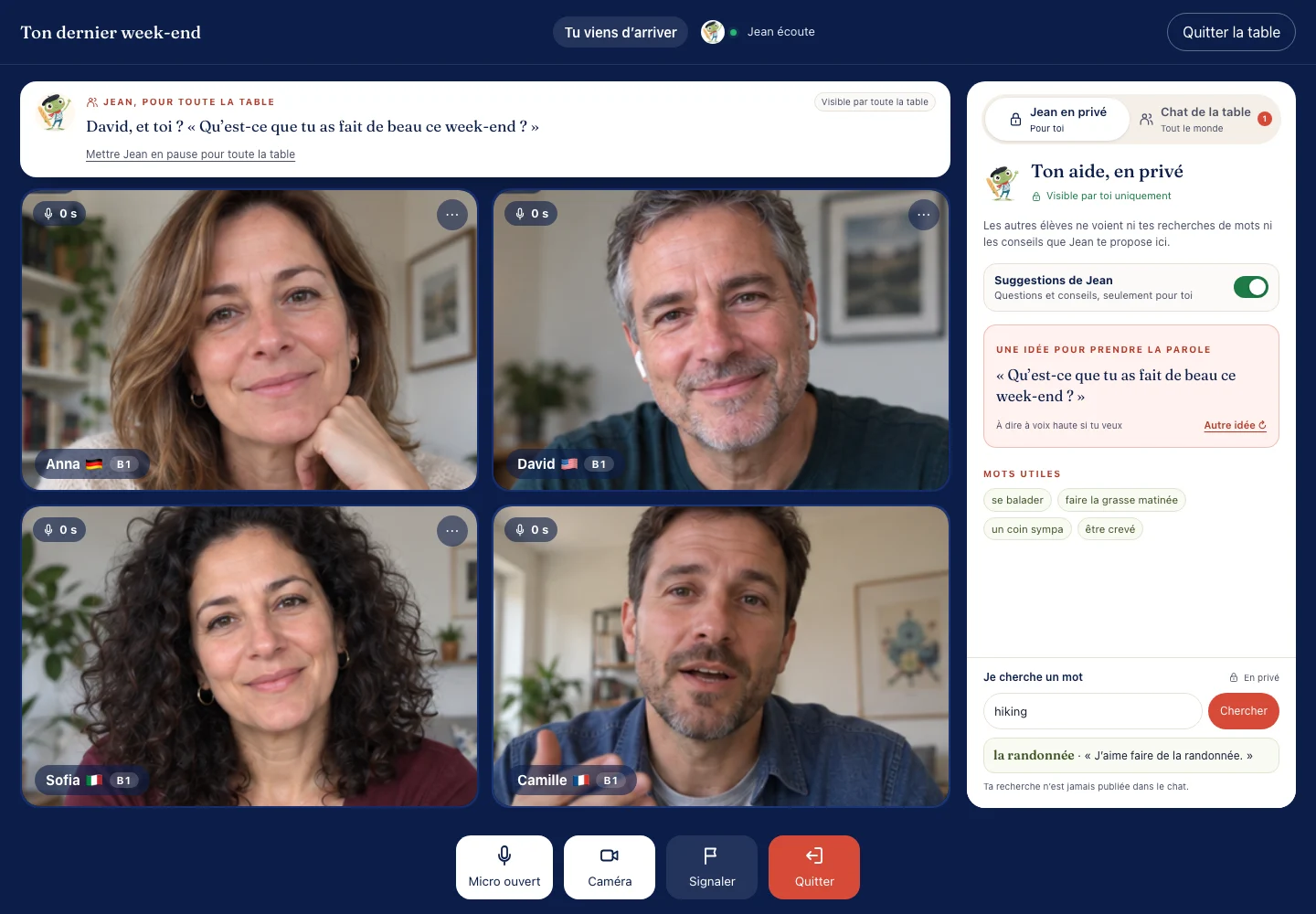
Jean is at every table. He opens the conversation by going around the table, gets the group talking again when a silence settles in, and suggests an idea if you don't know what to say. When a word escapes you, you type it in your own language and Jean gives you the French word privately: nobody else sees it. The camera is optional, there's a topic to help you get started, and nobody expects you to speak perfectly. After the table, if you've spoken enough for him to put one together, you get a personal report with the corrections for your sentences and a spoken debrief from Jean.
The tables are included in the subscription at no extra cost, including during the 7 free days.
What stands out
- You practice alone with Jean whenever you want, and with real people every week, in the same subscription.
- With the annual plan, if you like, you can have a one-on-one 30-minute video call with Elisabeth midway through the course to review your progress.
The limits
- The course is for people who already have some French (A2 to C1), not for true beginners.
- The tables are brand new, so there are still few sessions outside Sunday evening.
- The subscription isn't free.
Price: €15.75/month (€189/year, billed once), with 7 days free on the annual plan. Card required: nothing is charged if you cancel during the 7 days, and you can turn off renewal from your profile afterwards. There is also a monthly plan at €34.99/month, with no free trial.
2. Duolingo Max - short scenarios with a character
Duolingo Max is Duolingo's most complete plan, and it's available for French. It adds two speaking features. The first, "Video Call," is a video call with Lily, a character who remembers your earlier conversations. The second, "Roleplay," has you act out everyday scenes with characters from the app, then the AI comments on the accuracy and complexity of your answers.
What stands out
- You stay in an app you may already know.
- Lily remembers what you talked about on your previous call, which gives some continuity.
The limits
- The scenes are designed by Duolingo, so you don't really choose what the conversation is about.
- You only talk to an AI, never to a person.
- Max is a paid tier above Super Duolingo, on iOS and Android. Pricing depends on your country and is shown in the app.
3. Speak - learn phrases, then use them
Speak offers French among the six languages you can learn from English. It works in three steps: you learn phrases, you practice saying them, then you use them in conversation with an AI tutor. The app gives you pronunciation feedback in real time, and you can try again as many times as you need.
What stands out
- The path takes you from useful phrases to conversation, which helps if you don't know where to start.
- Pronunciation feedback comes while you speak.
- Two plans, Premium and Premium Plus, and a 7-day trial.
The limits
- You only practice with an AI, with no human on the other end.
- Pricing depends on your region and is shown in the app.
4. Praktika - avatars to practice out loud
Praktika is built around voice conversation with AI-driven avatars. The feedback covers your pronunciation, your grammar, and your word choice. You choose the tone of the corrections (soft, balanced or strict), and your tutor can explain things in your own language, which helps when you're still unsure of yourself.
What stands out
- You decide how demanding the corrections should be.
- Explanations can be given in your own language.
- The price on the official site, about $8 a month, is easy on the budget.
The limits
- You talk to AI characters rather than real people.
- As with Speak, there is no human contact in the practice.
5. Online private lessons (italki and Preply)
Both platforms put you on video with a teacher or tutor of your choice. It's the closest thing to a real conversation, with someone who can explain why you're getting it wrong. According to italki, French tutors there cost between $4 and $60 an hour, and you can book up to three trial lessons, one per tutor. On Preply, lessons start at $3 and cost $21 on average, and the platform says that if your first tutor isn't a match, you can try two more for free.
What stands out
- A real person adapts to what you need.
- You choose your tutor, your budget and your schedule.
- Trial lessons help you find the right person.
The limits
- The cost climbs quickly if you want to talk several times a week.
- Prices, and experience, vary a lot from one tutor to the next.
- You have to book ahead, which doesn't help when you feel like practicing on a Tuesday at 10 pm.
6. Language exchange (Tandem and HelloTalk)
Tandem and HelloTalk are free. The idea: you chat with French speakers who are learning your language, through written messages, voice messages, audio calls, or video calls. Tandem has built-in correction and translation tools, and HelloTalk also offers group audio rooms, called Voicerooms.
What stands out
- It's free, and you talk with real French speakers.
- You can start in writing, then move on to audio and video at your own pace.
The limits
- There's no structure or progression: you have to decide what to talk about and how to move forward.
- It all depends on who you end up talking to, and nothing guarantees you'll find a regular partner.
- You're also helping the other person with your language, so part of the time isn't spent in French.
7. ChatGPT voice mode - open-ended, but without structure
ChatGPT isn't a language app, but its voice mode allows a free conversation in French. It can be very useful if you know how to give it instructions, for example asking it to correct you after every sentence or to stay at a simple level.
What stands out
- You can pick any topic, with no set program.
- You can ask it to correct you however you like.
The limits
- There's no learning path and no tracking of your progress.
- Corrections only come if you ask for them.
- On the free plan, voice mode has its own usage limits.
At a glance
If you want a quick comparison, here are the options we just covered: who you talk to, and the price listed in October 2026.
| Option | Who you talk to | Price (October 2026) | Ideal if… |
|---|---|---|---|
| 360 French Immersion | Jean (an AI) and other learners at the conversation tables | €189/year (€15.75/month) or €34.99/month | you want to practice alone whenever you like and with real people every week (levels A2 to C1) |
| Duolingo Max | An AI (Lily, characters) | Varies by country | you already use Duolingo and want short scenarios |
| Speak | An AI tutor | Varies by region | you want to learn ready-made phrases and then use them |
| Praktika | AI avatars | About $8/month | you want to set how demanding the corrections are |
| italki / Preply | A teacher or tutor | Hourly, depending on the tutor | you want explanations from a real person |
| Tandem / HelloTalk | French speakers who are learning your language | Free | you want to talk with people for free and don't need structure |
| ChatGPT (voice mode) | A general-purpose AI | Free (limited) or paid | you know how to give precise instructions |
None of these is the right choice for everyone: the best one is the one you will actually open several times a week.
How to choose
The right choice depends on what's holding you back, not on which app is best known. A few pointers:
- You're afraid of making mistakes in front of someone: start with an AI (Jean, Speak, Praktika, or Duolingo Max). You can repeat as many times as you like without feeling judged.
- You want to talk with real people without paying for each lesson: the conversation tables in 360 French Immersion, or a language exchange like Tandem or HelloTalk.
- You want explanations from a teacher: italki or Preply, and plan for at least one session a week in your budget.
- You like to set everything up yourself: ChatGPT voice mode, with precise instructions.
Our advice: don't choose between AI and people. The AI helps you warm up and regain confidence, and people teach you to hold a real conversation, with its silences and surprises. That's what we wanted to bring together in 360 French Immersion, but you can also build your own mix from the tools on this list.
Phrases that save you when you freeze
Freezing in the middle of a sentence is normal, even when you know the words. These few phrases buy you time and let you stay in French instead of switching back to English.
- Tu peux répéter, s'il te plaît ? (Can you repeat that, please?) - when you didn't catch what the other person just said.
- Tu peux parler un peu moins vite ? (Can you speak a little more slowly?) - when things are going too fast for your ear.
- Comment on dit ça en français ? (How do you say that in French?) - when a word is missing and you want to learn it on the spot.
- Attends, je cherche le mot. (Wait, I'm looking for the word.) - it tells the other person you're thinking, so they give you a moment.
- C'est un truc qui sert à… (It's a thing that is used to…) - a way around a word you don't know: you describe it, for example « C'est un truc qui sert à ouvrir les bouteilles » (a thing used to open bottles).
- Attends, je reformule. (Wait, let me rephrase.) - for when your sentence is going off track and you'd rather start again.
- Si j'ai bien compris, tu veux dire que… (If I understood correctly, you mean that…) - to check you've followed before you answer.
- Laisse-moi réfléchir une seconde. (Let me think for a second.) - buys you a little time without an awkward silence.
- Et toi, qu'est-ce que tu en penses ? (And you, what do you think?) - hands the conversation back, often after you've answered their question.
A note on tu and vous: these phrases are written for talking to another learner or a friend, using the informal tu. With a stranger or in a formal situation, you use vous instead: « Vous pouvez répéter, s'il vous plaît ? » or « Si j'ai bien compris, vous voulez dire que… ».
A simple week to get started
Here is one suggestion, which you can adapt to your schedule: about 15 minutes a day, without trying to do more.
- Monday, Tuesday and Wednesday: a short spoken conversation with an AI about an everyday situation (ordering at a café, asking for directions, talking about your day), then note two or three corrections.
- Thursday: deliberately reuse those corrections, either in a new conversation or by saying them aloud in sentences of your own.
- Friday and Saturday: two more short conversations on other situations, again noting two or three corrections.
- Sunday: a conversation with real people. If you follow 360 French Immersion, that can be a conversation table on Sunday at 7 pm, Paris time. Otherwise, a language exchange or a lesson works just as well.
- The tip that matters: aim for regularity rather than length. Fifteen minutes almost every day is better than one long session now and then.