Transcript
Hi everyone, welcome to this new French video.
I hope you're doing well and comfortably settled in. Remember that if you need them, you can turn on French or English subtitles.
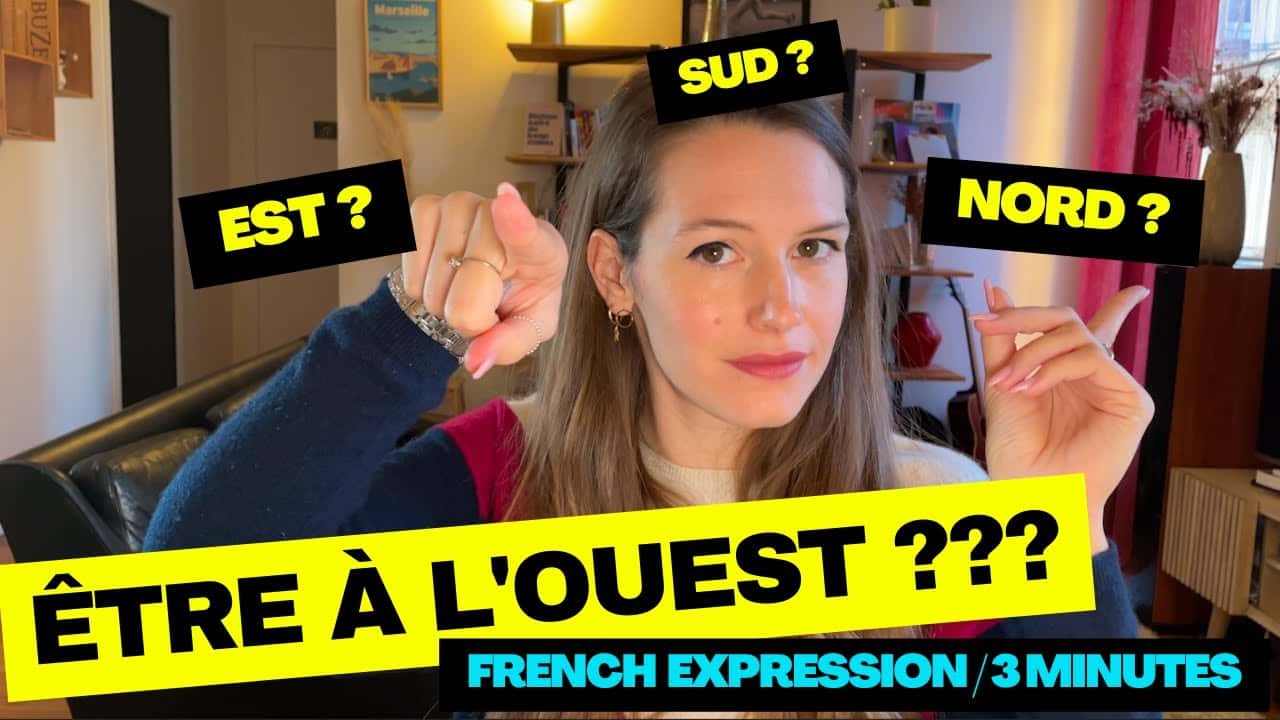
Today, we're going to look at a French expression in just a few minutes. This expression is "etre a l'ouest" (to be in the west).
"L'ouest" (the west) - you heard right, it refers to the cardinal direction. North, South, East, West. The cardinal directions.
When you say someone is "a l'ouest," they're not physically facing west - you don't need to grab a compass to check.
It's an expression that means someone is a bit spaced out, lost in their thoughts, not in tune with reality. You might say someone "has their head in the clouds."
You're physically present, but mentally you're somewhere else. It's an informal expression used mainly in two contexts. The first is what I just described - when you're lost in your thoughts, not focused on what's happening around you.
You're awake, but you're sort of daydreaming. For example, if you're in a meeting at work - and I'm sure this has happened to you before, it used to happen to me all the time - you're in this meeting and you start drifting off into your thoughts and stop paying attention to what's going on.
And someone asks you: "So, what do you think?" Then you have to admit you weren't paying attention and ask them to repeat. And your colleague might say: "You're completely a l'ouest" (totally spaced out) or "you look a bit a l'ouest."
Of course, as I said, it's a fairly informal expression, so it depends on your work environment. But in any case, you were "a l'ouest" - that's for sure.
As I was saying, you weren't focused. You weren't paying attention.
You can also use this expression to describe someone who is "a cote de la plaque" - to use another very informal French expression.
When someone is "a l'ouest" or "a cote de la plaque," it can describe someone who is out of touch with reality. So it's not necessarily about a specific moment of spacing out - it's more of a general trait, someone who doesn't quite grasp how things really are.
For example, if someone tells me they want to buy a 100-square-meter apartment in Paris with a budget of 200,000 euros, I could say: "You're completely a l'ouest, completely a cote de la plaque." Those prices don't match reality at all.
They're "a l'ouest" - not in touch with reality.
That's it for this expression. I hope you liked it and understood it well. Tell me in the comments if there are other French expressions you'd like me to explain.
If you liked this video, of course, as always, give it a thumbs up. And if you're new here, subscribe and turn on notifications so you don't miss any of my videos.
See you very soon!