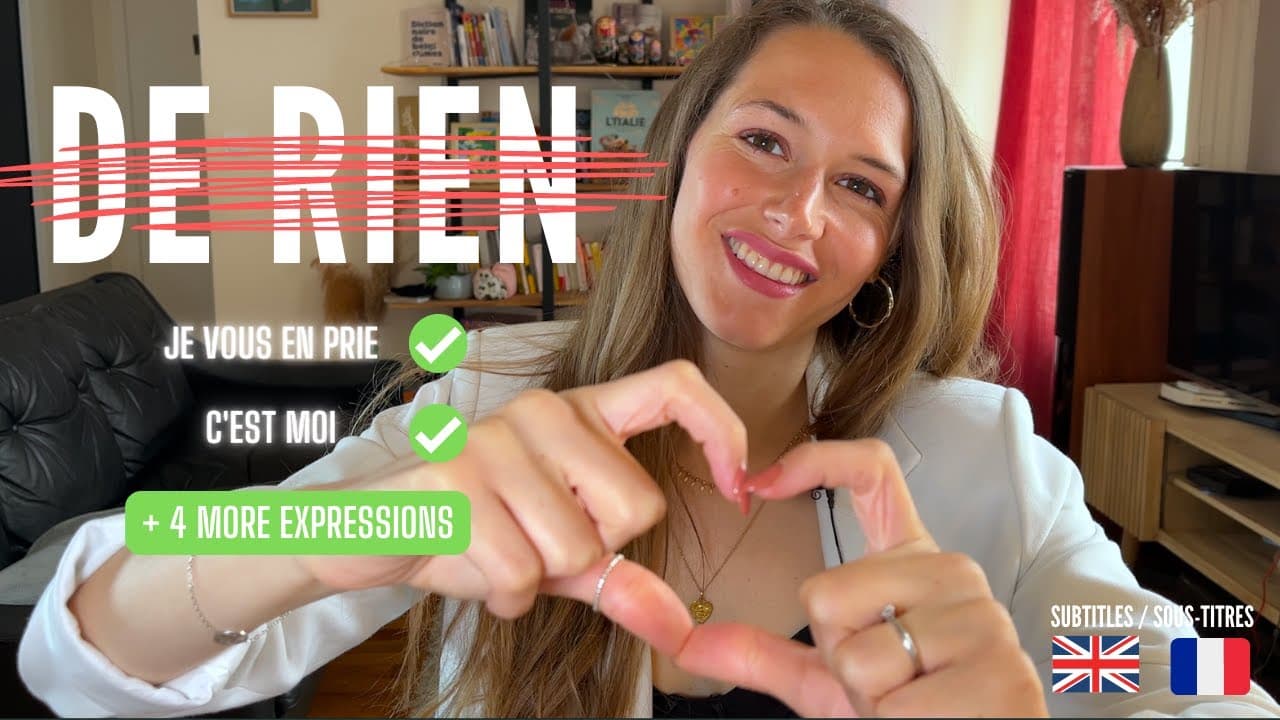
« De rien » ("You're welcome") is the first thing you learn when studying French. It is not wrong, but it is a bit like answering "fine" when someone asks how you are in English - it is the most basic response, the one everybody knows. French people, however, use many other expressions depending on the context, the person and the level of formality.
1. Je vous en prie
This is the most classic, most formal and most polite alternative. You use it when addressing someone with « vous » - someone you do not know, in a professional setting or in a shop.
Example: you are on holiday in Paris and you ask the receptionist at your hotel if they know any good restaurants. They answer you, you thank them, and they will almost certainly reply « je vous en prie » ("You're welcome" - formal).
2. Je t'en prie
This is exactly the same phrase, but in its informal « tu » version. You use it with friends, family or close colleagues. It remains fairly formal despite the « tu ». For example, at the table: « Tu peux me passer le sel s'il te plaît ? » - « Tiens. » - « Merci beaucoup ! » - « Je t'en prie. »
3. Avec plaisir
« Avec plaisir » ("With pleasure") means "you're welcome," but with an added dimension: you are expressing that it truly gave you pleasure to help the person. It is warmer and friendlier. This expression works equally well in spoken French and in emails.
« Est-ce que vous pourriez m'aider à réviser pour mon examen de français ? » - « Bien sûr ! » - « Merci beaucoup ! » - « Avec plaisir. »
4. Tout le plaisir est pour moi
This one is very formal. You mostly hear it in professional or elegant settings - an upscale restaurant, a business meeting. You use it when you truly want to emphasize that it was a pleasure for you.
For example, after an interview: « Merci d'avoir accepté de me rencontrer. Cela m'a vraiment beaucoup aidé pour mon mémoire de fin d'études. » - « Tout le plaisir est pour moi. »
5. Il n'y a pas de quoi
Here, we are in more casual territory. The implied meaning is « il n'y a pas de quoi me remercier » ("Don't mention it") - it is not even worth saying thank you. You use it among friends, family or close colleagues.
And since the French love contractions, you will very often hear « Y'a pas de quoi » instead of « Il n'y a pas de quoi ». This is typical of everyday spoken French.
6. C'est moi
« C'est moi » may seem odd at first. In reality, it is a shortened form of « c'est moi qui vous remercie » ("I am the one who should thank you"). You use it especially when the benefit is mutual.
For example, at the bakery: « Bonjour, je voudrais deux croissants et une baguette, s'il vous plaît. » The baker hands them to you, you say « Merci », and she replies « C'est moi » or « Merci à vous » - because you, too, have done her a favour by buying from her.
NB: of all these expressions, « avec plaisir » is probably the most versatile. It works in almost every context, both in speech and in writing, and it gives a warm and friendly impression.