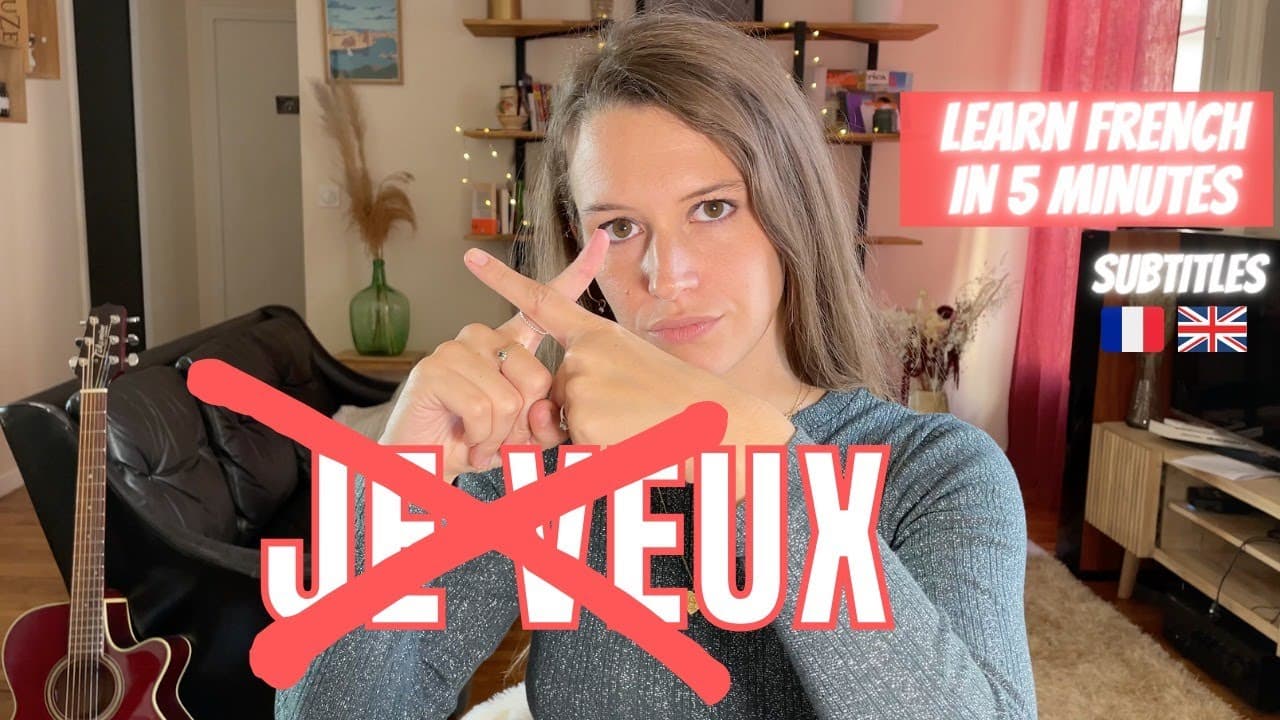
You may already know this: in France, politeness is something truly important. Always saying « merci » , « s'il vous plaît », « bonjour » , « passez une bonne journée »... French people can get offended very quickly if you do not observe the proper etiquette, whether in a shop, a restaurant, a cafe, or at work.
One of the most common mistakes among French learners is using the verb « vouloir » in the present tense when addressing someone. Here is why it is a trap and how to avoid it.
The problem with « je veux »
When you learn French, you naturally start with the present tense conjugation: « je veux, tu veux, il veut... ». It makes sense - it is the tense you use the most. But with the verb « vouloir », using the present tense when speaking to someone gives the impression that you are giving an order. « Je veux un coca » sounds aggressive to a French person's ears.
The solution: « je voudrais »
« Je voudrais » ("I would like") is the conditional form of the verb « vouloir ». It is a much softer way of expressing what you want. It gives the impression that it is a wish, not a demand. The person you are speaking to feels as though they have a choice.
And generally speaking, when you ask someone for something politely, there is a much better chance they will be kind in return.
Practical examples
Here are a few everyday situations:
- At a cafe: do not say « je veux un coca » but rather « je voudrais un coca »
- In a shoe store: « je voudrais essayer ce modèle en taille 40 »
- In a meeting or during a guided tour: « je voudrais poser une question »
- On the street: « excusez-moi , je voudrais passer »
- At a restaurant, in a group: « on voudrait une table pour six pour dîner »
« On » rather than « nous » in spoken French
You may have noticed the last example: « on voudrait » instead of « nous voudrions ». In spoken French, people use « on » far more often than « nous » when referring to a group. « Nous voudrions » is grammatically correct but very formal. In practice, you will hear « on voudrait une table pour six pour dîner » much more often.
« On » followed by the third person singular conjugation replaces « nous » in the vast majority of everyday conversations.
NB: this politeness rule also applies to other phrasings. Prefer « j'aimerais » ("I would love to") over « je veux », and « pourriez-vous » ("could you") over « pouvez-vous » for a polite request.