Transcript
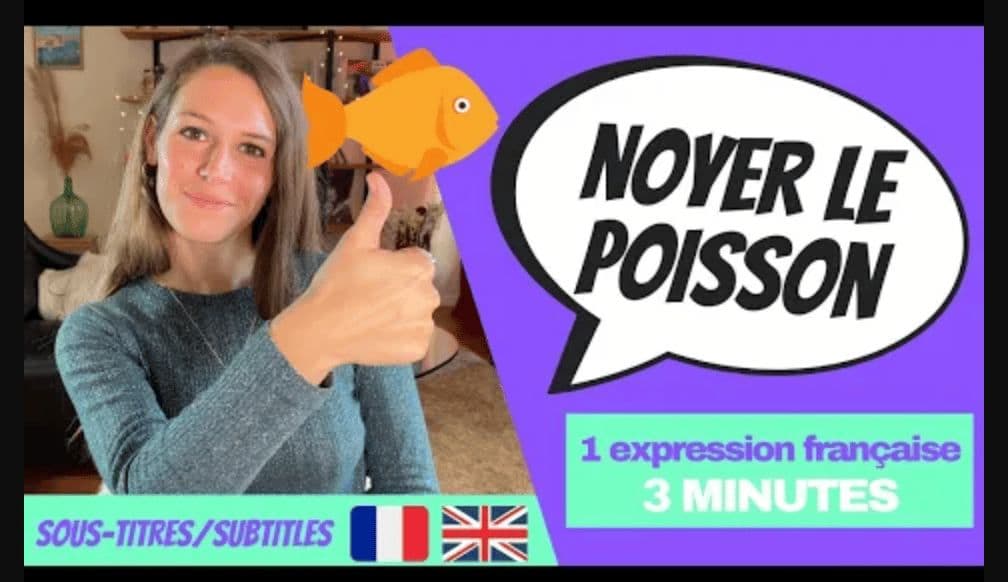
Bienvenue dans ce format de vidéo où nous voyons en quelques minutes une expression française. Aujourd’hui, on va voir l’expression “noyer le poisson”. Cette expression est un peu étrange parce que noyer un poisson, c’est impossible : le poisson respire dans l’eau !
On va voir ce que veut dire cette expression, des mises en contexte et surtout, d’où elle vient.
Quand on dit qu’on essaye de noyer le poisson, ça veut dire qu’on essaye de détourner une conversation. Imaginez : vous êtes en train de discuter avec quelqu’un, et un sujet est abordé. Mais vous, vous n’avez pas envie d’en parler. Vous essayez vraiment de détourner la conversation pour qu’on ne parle plus de ce sujet. Peut-être parce que ça vous gêne, parce que ça vous embarrasse, ou parce que vous avez promis à quelqu’un de ne pas en parler. Donc, vous essayez de noyer le poisson : vous essayez d’enterrer le sujet et de passer à autre chose dans la conversation.
Je vais vous donner des mises en contexte, ça va vous aider à mieux comprendre.
Voici un premier exemple. On peut dire que les politiques essayent souvent de noyer le poisson quand ils n’ont pas la réponse à une question. Si on demande à un homme politique combien coûte un ticket de métro à Paris, il va peut-être répondre : “L’important, ce n’est pas combien coûte le ticket de métro, mais combien on rembourse chaque année aux personnes qui prennent le métro.”
Vous voyez, là, il a parfaitement noyé le poisson. En fait, il ne savait pas répondre à la question. Donc, il a détourné la conversation. Il a caché qu’il ne connaissait pas la réponse en changeant de sujet.
Voici un autre exemple. Si vous avez une amie qui est enceinte mais qui n’a pas encore envie de le dire, et que quelqu’un vous dit : “Est-ce que tu as remarqué ? Maria a vraiment grossi. Tu crois qu’elle est enceinte ?”
Vous, vous gardez le secret, vous ne voulez pas en parler. Donc, vous allez essayer de noyer le poisson, de détourner la conversation. Par exemple, vous pouvez répondre : “Ah, je ne sais pas, je n’ai pas remarqué. Par contre, je ne sais pas si tu as vu Sandra, mais elle est à son huitième mois de grossesse. Elle est vraiment énorme !”
Vous avez détourné la conversation, vous avez noyé le poisson.
Cette expression vient du monde de la pêche. Quand un pêcheur attrapait un gros poisson, il le fatiguait en le laissant nager en rond dans l’eau pour l’épuiser avant de le sortir. On “noyait” le poisson, c’est-à-dire qu’on l’embrouillait, on le désorientait. Et c’est exactement ça qu’on fait quand on noie le poisson dans une conversation : on embrouille l’autre personne pour qu’elle oublie sa question.
Voilà, c’est fini pour cette expression. J’espère que cette vidéo vous a plu. Si elle vous a plu, pensez bien sûr à mettre un pouce. N’hésitez pas à me dire en commentaire s’il y a des expressions que vous voudriez que j’explique et que je mette en contexte. Je vous souhaite à tous une très belle journée et je vous dis à très, très vite.